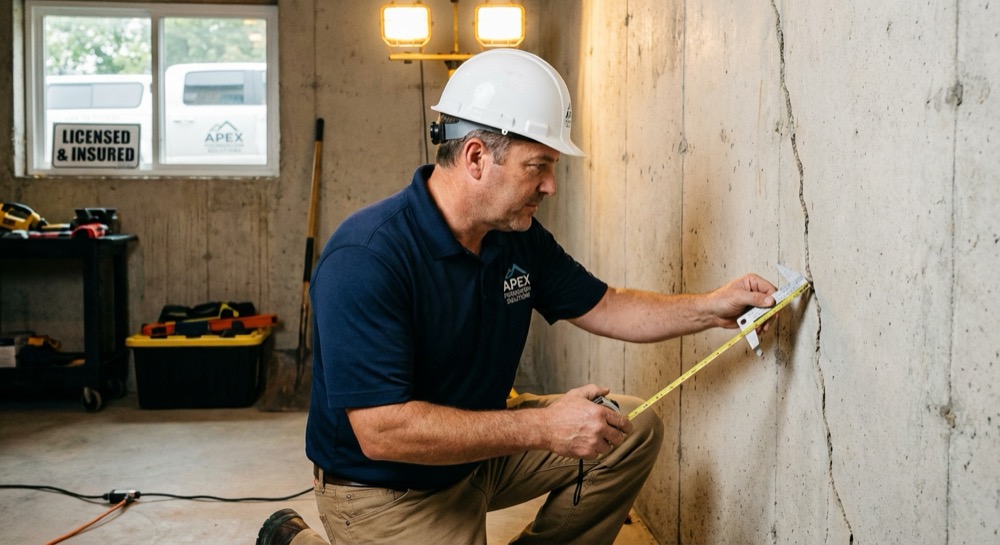
You have noticed cracks in the drywall, a door that will not latch, or a floor that slopes when you drop a marble. Something is going on with your foundation. Now comes the question that trips up most homeowners: do you call a structural engineer or a foundation repair contractor?
The answer depends on the severity of the problem, whether money is changing hands on the house, and how much you are willing to spend upfront for an independent opinion. This guide breaks down what each professional does, what they charge, and the specific situations where one is clearly the better first call.
What Structural Engineers Actually Do
A structural engineer (SE) is a licensed professional who diagnoses problems but does not fix them. Think of them as the doctor who reads your X-rays and writes the treatment plan, then sends you to a surgeon for the procedure.
Their job is to assess the structural integrity of your home and determine:
- What is causing the movement -- soil conditions, hydrostatic pressure, poor original construction, plumbing leaks, tree root intrusion, or natural settling
- How severe the damage is -- cosmetic, moderate, or structurally compromised
- What repair method is appropriate -- helical piers, push piers, wall anchors, carbon fiber, mudjacking, or sometimes nothing at all
- Whether the foundation is safe to live on as-is or requires immediate intervention
Engineers carry professional liability insurance (errors and omissions coverage) and put their license on the line with every report. If they call a crack cosmetic and the wall collapses, they face legal and professional consequences. That accountability is what you are paying for.
Structural engineers are licensed by the state and must pass the 16-hour SE exam (in states that require it) or the PE exam with a structural concentration. They are not affiliated with any contractor and have no financial incentive to recommend unnecessary repairs.
What Foundation Repair Contractors Do
Foundation repair contractors are the ones who do the physical work. They install piers, patch cracks, reinforce walls, and perform the actual repairs to stabilize your foundation.
Most reputable contractors offer a free inspection. During that visit, a sales representative or project manager will examine the visible symptoms -- cracks, bowing walls, sticking doors, floor slopes -- and recommend a repair plan with a price. Many use proprietary assessment tools like manometers (to measure floor levelness) or crack monitors.
The good contractors are experienced, knowledgeable, and genuinely helpful. They see hundreds of foundations per year and can often spot the problem quickly. But they are also in the business of selling repairs, which creates an inherent tension that homeowners need to understand.
Side-by-Side Comparison
| Factor | Structural Engineer | Foundation Repair Contractor |
|---|---|---|
| Role | Diagnoses the problem, writes a repair specification | Performs the physical repair work |
| Licensing | State-licensed PE or SE designation | Contractor license (varies by state) |
| Inspection Cost | $300 to $800 for a written report | Free in most cases |
| Incentive | Paid for their opinion; no benefit from recommending repairs | Paid to perform repairs; revenue depends on selling jobs |
| Report | Stamped engineering report with cause, severity, and recommended fix | Proposal/estimate with scope and price |
| Liability | Professional E&O insurance; license at stake | General liability and workmanship warranty |
| Best For | Objective diagnosis, legal/insurance documentation, second opinions | Getting repair quotes, scheduling work, warranty coverage |
Need a Foundation Repair Quote?
Get up to 3 free estimates from vetted, licensed contractors in your area. Compare before you commit.
Get Free QuotesWhen You Need a Structural Engineer First
There are specific situations where spending $300 to $800 on an independent engineering assessment before calling a contractor is clearly the right move. If any of these apply to you, start with the engineer.
Buying or Selling a Home
If a home inspection flagged potential foundation issues during a real estate transaction, an engineering report gives you hard data. Buyers use it to negotiate the price down or require repairs before closing. Sellers use it to prove the damage is cosmetic and avoid inflated repair demands. Either way, a stamped SE report carries far more weight than a contractor's estimate in negotiations.
Filing an Insurance Claim
Homeowner's insurance rarely covers foundation damage from settling, but if the cause is a covered peril -- a burst pipe, a sudden sinkhole, or storm damage -- you will need an engineering report to support your claim. Insurance adjusters are trained to minimize payouts. A stamped report from a licensed SE documenting the cause and extent of damage is the strongest evidence you can submit.
Getting a Second Opinion
A contractor told you that you need $15,000 worth of piers. That might be accurate, or it might be overkill. An engineer can confirm whether the recommended scope is appropriate, suggest alternatives the contractor did not mention, or tell you the issue is minor and monitoring is sufficient. The $500 engineering fee can easily save you $5,000 or more if the contractor's proposal is excessive.
Severe or Unusual Damage
Horizontal cracks in basement walls, floors that slope more than one inch over 15 feet, gaps between walls and ceilings wider than half an inch, or visible displacement of the foundation itself -- these are signs of serious structural problems. You need an engineer to assess whether the home is safe to occupy and to specify the correct repair approach before anyone starts drilling.
Dispute With a Contractor
If a previous foundation repair failed, if you suspect the work was done incorrectly, or if you are in a warranty dispute with a contractor, an engineer's independent assessment provides the documentation you need. Their report can serve as evidence in small claims court, arbitration, or a formal complaint to the state licensing board.
Your Lender or Insurance Company Requires It
Some mortgage lenders require a structural engineering report before approving a loan on a home with known foundation issues. FHA and VA loans in particular may require this documentation. Similarly, if you are refinancing and the appraiser notes foundation concerns, the lender may require an SE report before proceeding.
The common thread: call an engineer first when money, legal documentation, or safety are on the line. The cost of the report is trivial compared to the cost of a bad decision on a $10,000+ repair.
When a Contractor Inspection Is Fine
Not every foundation concern requires an engineering assessment. In many cases, going directly to a contractor for a free inspection is the practical and appropriate first step.
Minor Cosmetic Cracks
Hairline cracks (less than 1/8 inch wide) in poured concrete basement walls or slabs are extremely common and almost always related to normal curing and settling. A contractor can quickly confirm this and recommend monitoring or a simple epoxy injection if needed.
Routine Maintenance
If you need a sump pump installed, exterior waterproofing, or drainage corrections to prevent future foundation problems, a contractor is the right call. These are maintenance tasks, not structural diagnoses.
Known Simple Problem
If you already know the issue -- a single vertical crack that has been stable for years, a sticking door in one room during humid months -- a contractor visit can confirm what you suspect and provide a price. You do not need an engineer for straightforward, well-understood problems.
You Plan to Get Multiple Contractor Quotes
If you get three separate contractor inspections and all three recommend similar scope and pricing, that consensus gives you reasonable confidence in the diagnosis without the added cost of an engineering report. Where this breaks down is if the three contractors all recommend different approaches or wildly different pricing.
If multiple contractors give you conflicting diagnoses or the proposed repair costs exceed $8,000 to $10,000, stop and invest in an engineering report before moving forward. The disagreement itself is a signal that the situation is more complex than a standard inspection can handle.
Cost Comparison: What You Will Actually Pay
Structural Engineer Fees
For a residential foundation assessment, expect to pay between $300 and $800, depending on the size and complexity of the home, your geographic location, and the scope of the report. A basic visual inspection with a letter is at the low end. A full assessment with floor levelness measurements, crack documentation, soil analysis, and a detailed repair specification is at the high end.
Some engineers charge hourly ($150 to $350 per hour), while others use flat-rate pricing. If you need them to return for a follow-up inspection after repairs are completed, expect an additional $200 to $500.
Contractor Inspection Costs
The vast majority of foundation repair contractors offer free inspections. This is standard across the industry, whether you are dealing with a national franchise or a local company. The inspection typically takes 60 to 90 minutes and ends with a proposal and price.
There is no charge for the visit, but understand what you are getting: a sales consultation, not an independent assessment. The contractor is investing their time with the expectation that a percentage of inspections will convert to signed contracts.
| Service | Typical Cost | What You Get |
|---|---|---|
| SE Visual Inspection + Letter | $300 - $500 | Verbal assessment, short written summary of findings |
| SE Full Assessment + Report | $500 - $800 | Stamped report with measurements, photos, cause, severity, and repair spec |
| SE Follow-Up After Repair | $200 - $500 | Verification that repairs match the original specification |
| Contractor Inspection | Free | Visual assessment, proposed repair scope, and price estimate |
The "Free Inspection" Conflict of Interest
This is the part most homeowners do not think about until after they have signed a contract.
A foundation repair company makes money by performing repairs. When they send someone to your home for a free inspection, that person's job is to assess the foundation and sell a project. Most companies pay their inspectors a base salary plus commission on signed contracts. Even at companies that claim "no commission," the inspector's performance is measured by their close rate.
This does not mean every contractor is going to recommend unnecessary work. Many are honest and professional. But the structural incentive is real and worth understanding:
- An engineer who finds nothing wrong still gets paid their full fee. They have zero incentive to exaggerate.
- A contractor who finds nothing wrong just spent 90 minutes on a visit that generated zero revenue. That creates a subtle -- sometimes not so subtle -- pressure to find something to fix.
This is exactly why the engineer-first approach makes sense for major issues. A $500 report that says "this damage is cosmetic and requires monitoring, not repair" can save you from a $12,000 contract you did not need.
Conversely, a report that confirms serious structural damage and specifies exactly which repair method is appropriate gives you leverage when comparing contractor quotes. You know what needs to be done, and you can hold each contractor accountable to that specification.
Compare Foundation Repair Contractors
Already have your engineer's report? Get matched with contractors who can execute the recommended repairs.
Get Free QuotesWhat Is in a Structural Engineering Report
A proper engineering report is not a one-page letter. For a residential foundation assessment, expect a document that includes:
- Property description -- address, age of home, foundation type (slab, pier and beam, basement), soil type if known
- Floor levelness data -- measurements taken across the slab, typically documented in a grid pattern showing relative elevation differences
- Crack documentation -- location, width, pattern (vertical, horizontal, stair-step), and direction of movement
- Probable cause -- what is driving the movement (expansive clay, poor drainage, plumbing leak, inadequate original design)
- Severity assessment -- whether the damage is cosmetic, functional (affecting livability), or structural (affecting safety)
- Repair recommendation -- specific method, number of piers and locations (if applicable), expected outcome
- Photos -- documented evidence of every issue noted in the report
- PE/SE stamp and signature -- the engineer's professional seal, which makes the document legally binding
The stamp is the key differentiator. A stamped engineering report is a legal document that carries the engineer's professional liability. It can be submitted to courts, insurance companies, lenders, and real estate closing tables. A contractor's inspection report, no matter how thorough, does not carry this legal weight.
Using the Report to Negotiate With Contractors
One of the most practical uses of an engineering report is as a negotiating tool. Here is how it works:
- Get the SE report first. It specifies exactly what needs to be done -- for example, "install 8 steel push piers along the south and east walls to stabilize and lift the settled portion of the slab."
- Send the report to 3 or more contractors. Ask each one to bid on the specific scope outlined in the report, not their own assessment. This creates a true apples-to-apples comparison.
- Compare bids on equal footing. Because every contractor is bidding on the same scope, the only variables are price, warranty, timeline, and reputation. You eliminate the problem of one contractor recommending 6 piers and another recommending 14.
- Hold the contractor accountable. After the work is done, you can hire the engineer to return for a follow-up inspection ($200 to $500) to verify the repairs match the original specification.
This approach typically saves homeowners 10% to 30% on the final repair cost, easily paying for the engineering report many times over.
How to Find a Qualified Structural Engineer
Finding an SE who specializes in residential foundations is not difficult, but it takes more than a Google search. Here are the most reliable sources:
- ASCE (American Society of Civil Engineers) -- their member directory at asce.org lets you search by location and specialty. Look for engineers who list residential or geotechnical as a focus.
- State licensing board -- every state maintains a database of licensed professional engineers. Search your state's board of professional engineers to verify credentials and check for disciplinary actions.
- NCSEA (National Council of Structural Engineers Associations) -- their directory at ncsea.com connects you with state-level structural engineering associations, many of which offer referral services.
- Real estate agent referrals -- experienced agents in your area regularly work with structural engineers during transactions and can recommend ones who are responsive, thorough, and fair in their assessments.
- Your home inspector -- if a home inspector flagged the foundation issue, they likely have a list of SEs they refer to regularly.
Before hiring, confirm the engineer holds a current PE (Professional Engineer) or SE (Structural Engineer) license in your state. Ask whether they carry professional liability (E&O) insurance. If they hesitate on either question, move on.
Real Estate Transaction Considerations
Foundation concerns during a home sale create a high-stakes situation where the distinction between an engineering report and a contractor estimate matters enormously.
If You Are the Buyer
A home inspection flagged "evidence of foundation movement" or "cracks consistent with settling." Your options are to walk away, negotiate the price down, or require the seller to make repairs before closing. In all three scenarios, an engineering report gives you the strongest position. It tells you exactly how serious the problem is and what the repair will cost, backed by a licensed professional's stamp.
Without an SE report, you are negotiating based on a contractor's free estimate -- which the seller can dismiss as inflated, since the contractor has a financial incentive to recommend more work.
If You Are the Seller
Getting ahead of foundation concerns with a pre-listing engineering report can actually help you. If the engineer determines the cracks are cosmetic and the foundation is structurally sound, that stamped report neutralizes the issue before it derails negotiations. If repairs are needed, you can get them done on your terms and timeline rather than scrambling during the closing process.
Lender Requirements
FHA, VA, and USDA loans have property condition requirements. If the appraiser notes foundation concerns, the lender may require a structural engineering report before approving the mortgage. In this case, the report is not optional -- it is a condition of financing. The buyer typically pays for it, but this is negotiable between buyer and seller.
Foundation Issues Holding Up Your Sale?
Get matched with local foundation repair pros who can move fast on repair work for real estate transactions.
Get Free QuotesThe Bottom Line
The decision is simpler than it seems once you understand what each professional brings to the table.
Call a structural engineer first when:
- You are buying or selling a home
- You need documentation for an insurance claim
- The damage looks severe or unusual
- You want a second opinion on a contractor's recommendation
- A lender requires a report
- You are in a dispute with a contractor about previous work
- The proposed repair cost exceeds $8,000 to $10,000
Start with a contractor inspection when:
- You have minor, hairline cracks and no other symptoms
- You need routine maintenance (drainage, waterproofing, sump pump)
- You have a well-understood, straightforward problem
- You plan to get three or more independent estimates for comparison
For anything in between, the safest path is the $300 to $800 engineering report. It is the cheapest insurance you can buy against an unnecessary $10,000 repair, and it is the strongest documentation you can have if you do need major work done.
Think of it this way: an engineer works for you. A contractor's free inspection works for the contractor. Both have a role, but understanding that distinction helps you make a decision that protects your wallet and your home.