The Quick Version: Foundation Crack Severity at a Glance
| Crack Type | Severity | Typical Cause | Avg. Repair Cost |
|---|---|---|---|
| Hairline (<1/8") | Low | Normal curing/settling | $150 -- $400 |
| Vertical | Moderate | Concrete shrinkage, settling | $300 -- $800 |
| Diagonal / Stair-Step | High | Differential settling | $500 -- $3,000+ |
| Horizontal | Critical | Hydrostatic pressure, soil expansion | $4,000 -- $15,000+ |
| Zigzag (block walls) | High | Mortar joint failure, lateral pressure | $1,500 -- $5,000+ |
| Wider than 1/4" | Critical | Active movement, structural shifting | $2,000 -- $12,000+ |
| Growing over time | Critical | Active settling, ongoing soil issues | $3,000 -- $20,000+ |
Finding a crack in your foundation can trigger instant anxiety. But before you spiral, understand this: almost every home develops foundation cracks at some point. The concrete curing process alone creates minor cracks in the first 1--3 years after construction. The real question is not whether you have cracks, but what kind of cracks you have.
Below, we break down every type of foundation crack you might encounter, what each one signals about your home's structural health, and exactly what you should do about it.
1. Hairline Cracks
Hairline Cracks (Less Than 1/8 Inch)
Low ConcernHairline cracks are the most common type of foundation crack and, in most cases, the least concerning. They typically result from the normal curing process. As poured concrete dries and hardens over the first 30 days -- and continues shrinking slightly over the first few years -- these thin surface cracks naturally appear.
Other common causes include minor temperature fluctuations (thermal expansion and contraction) and very slight settling as the soil beneath a new home compacts under the structure's weight.
What to do: In most cases, nothing. If you want to prevent water seepage through a hairline crack in a basement wall, a simple surface sealant or waterproofing paint will do the job. If a hairline crack has remained unchanged for more than a year, it is almost certainly cosmetic and poses no structural risk.
2. Vertical Cracks
Vertical Cracks (Straight Up and Down)
Moderate ConcernVertical cracks are the second most common type and are usually caused by concrete shrinkage during curing or normal foundation settling. In poured concrete walls, they tend to appear at the weakest structural points -- near the middle of a wall span or near window wells and pipe penetrations.
While less alarming than horizontal or diagonal cracks, vertical cracks deserve attention if they are wider than 1/8 inch, continue to grow, or are allowing water infiltration. A vertical crack that has grown noticeably wider over several months suggests active settling rather than simple shrinkage.
What to do: Most vertical cracks narrower than 1/8 inch can be sealed with epoxy injection or polyurethane foam injection. This bonds the crack and prevents water entry. If the crack is wider or actively growing, have a foundation specialist inspect it to rule out differential settling.
Key Takeaway
Vertical cracks under 1/8" that have not changed in size are typically benign. Seal them to prevent water intrusion and monitor annually. Only escalate if width increases or you notice displacement (one side of the crack sitting higher than the other).
3. Diagonal and Stair-Step Cracks
Diagonal Cracks (30--75 Degrees From Horizontal)
High ConcernDiagonal and stair-step cracks are one of the clearest indicators of differential settling -- meaning one section of your foundation is sinking or heaving at a different rate than another. This creates shearing forces that the foundation wall cannot absorb evenly, resulting in angled fractures.
In brick and block foundations, stair-step cracks are especially common because the mortar joints are the weakest points. The crack follows the path of least resistance, stepping through the mortar rather than breaking through the blocks or bricks themselves.
Common causes include expansive clay soils that swell and shrink unevenly, poor drainage that saturates one part of the foundation footprint but not another, tree roots drawing moisture unevenly from the soil, and improper or uneven compaction during construction.
What to do: Diagonal and stair-step cracks wider than 1/4 inch, or any that show displacement (one side of the crack sitting higher or further out than the other), need professional assessment. Minor stair-step cracking in older brick foundations can be repointed (mortar joints replaced), but larger or actively growing cracks may require underpinning with steel push piers or helical piers to stabilize the foundation.
Noticed Diagonal or Stair-Step Cracks?
Get a free structural assessment from vetted local foundation contractors. Compare quotes side by side -- no obligation.
Get Free Quotes4. Horizontal Cracks
Horizontal Cracks (The Most Serious Type)
CriticalHorizontal cracks are the single most dangerous type of foundation crack. They indicate that the wall is failing under lateral (sideways) pressure. The most common cause is hydrostatic pressure -- the outward force of water-saturated soil pushing against the foundation wall. In cold climates, frost heave creates similar forces. Expansive clay soils that swell significantly when wet are another frequent culprit.
When a foundation wall develops a horizontal crack, it means the wall has been loaded beyond its structural capacity. The wall is essentially being pushed inward, and the crack is where it is beginning to buckle. Left unaddressed, this can lead to partial or complete wall failure and catastrophic structural collapse.
Horizontal cracks are most common in poured concrete and concrete block walls. They tend to appear about one-third to halfway up the wall from the footer, where bending stress is highest.
What to do: Do not wait. Any horizontal crack in a foundation wall needs immediate professional evaluation. Common repairs include carbon fiber strap reinforcement for walls with less than 2 inches of inward deflection, steel I-beam bracing for more significant bowing, or in severe cases, full wall replacement or exterior excavation with drainage correction and wall anchors.
Warning: Do Not Ignore Horizontal Cracks
If you see a horizontal crack combined with visible wall bowing, this is a structural emergency. Do not stack heavy items against the wall, do not attempt a DIY fix, and call a structural engineer -- not just a contractor -- for an independent evaluation before any repair work begins.
5. Zigzag Cracks in Block Foundations
Zigzag Cracks (Block/CMU Walls)
High ConcernZigzag cracking in block foundations signals mortar joint failure, meaning the bonding material between the blocks is breaking down. This can be caused by lateral soil pressure (similar to the forces behind horizontal cracks), but it manifests differently in block walls because the mortar joints create natural weak points that absorb and redirect the stress.
The severity depends on the pattern's extent and any accompanying deformation. A short zigzag crack near a corner may indicate localized stress, while a zigzag crack running across most of a wall suggests widespread lateral pressure or settling.
What to do: Isolated, short zigzag cracks can be repaired by removing the damaged mortar and repointing the joints with fresh, high-strength mortar. For extensive zigzag cracking, especially if the wall is showing any inward bowing, more aggressive interventions like carbon fiber reinforcement, wall anchors, or full wall reconstruction may be needed.
6. Cracks Wider Than 1/4 Inch
Any Crack Exceeding 1/4" Width
Always ProfessionalRegardless of orientation, any foundation crack wider than 1/4 inch requires professional evaluation. At this width, the crack has moved well beyond normal curing shrinkage and indicates meaningful structural movement. The foundation has shifted, settled, heaved, or been displaced enough to create a gap that compromises the wall's integrity and likely allows significant water infiltration.
Wide cracks that are uniform in width from top to bottom typically indicate that the entire wall has shifted. Cracks that are wider at the top suggest the wall is tipping outward or the footing is sinking on one side. Cracks wider at the bottom may indicate the wall is being pushed inward at the base by soil pressure.
What to do: Call a foundation repair company for an inspection, and consider getting an independent assessment from a licensed structural engineer (PE) as well. Repair methods depend on the cause and may include underpinning (steel or helical piers), wall anchors, carbon fiber reinforcement, or foundation replacement.
7. Cracks That Grow Over Time
Actively Growing or Widening Cracks
CriticalA crack that changes size indicates active foundation movement. Even a hairline crack becomes a serious concern if it is actively growing. Active cracks mean the underlying cause -- whether it is soil settlement, hydrostatic pressure, tree root interference, or inadequate drainage -- is ongoing and has not stabilized.
Seasonal opening and closing (called "cyclical" movement) is common in regions with expansive clay soils and does not always indicate progressive failure. But cracks that steadily widen over time without closing back up indicate one-directional movement that will continue to worsen without intervention.
What to do: Install crack monitors (discussed below) and document the crack's progression over at least 2--3 months. If the crack is growing steadily, bring in a structural engineer for a load analysis. Repairs target the root cause: drainage correction, soil stabilization, underpinning, or root barriers.
Watching a Crack Get Bigger?
Active cracks mean active problems. Get matched with licensed foundation specialists who can diagnose the root cause and stop it.
Get Free QuotesWhere the Crack Is Matters as Much as What It Looks Like
The same crack type carries very different implications depending on where it appears. Here is a quick breakdown by location:
Foundation Walls (Basement or Crawl Space)
This is where cracks matter most. Foundation walls bear the lateral load of surrounding soil and the vertical load of the entire structure above them. Horizontal cracks in foundation walls are always structural. Vertical and diagonal cracks in foundation walls need evaluation if they exceed 1/8 inch or show signs of growth.
Floor Slabs (Basement or Slab-on-Grade)
Cracks in a concrete floor slab are extremely common and are usually not structural. The slab typically does not bear the weight of the house -- the perimeter foundation walls and footings do. Hairline and small cracks in a basement floor or garage slab are almost always caused by concrete shrinkage during curing. The exception: if a floor slab crack is accompanied by significant heaving (one side pushed up higher than the other), that can indicate expansive soil pushing upward, which affects the entire foundation system.
Above-Grade Walls (Interior Drywall, Exterior Brick/Stucco)
Cracks in interior walls, especially near door and window frames, can be an early indicator of foundation movement -- even before you spot cracks on the foundation itself. A diagonal crack running from the upper corner of a door frame toward the ceiling is a classic sign of differential settling. However, hairline cracks above doors and windows can also result from normal framing lumber shrinkage and are not always foundation-related.
How to Measure and Monitor Foundation Cracks
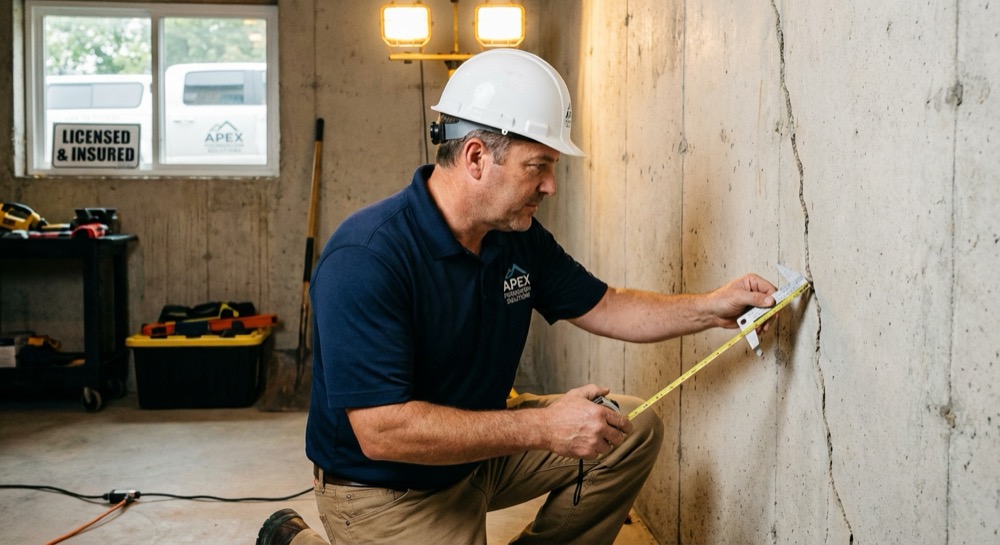
Before calling a professional, you can gather valuable data yourself. Here are three methods, from simplest to most precise:
The Penny Test (5-Second Check)
Place a penny edge-first into the crack. If the crack swallows the penny up to Lincoln's head (about 1/16 inch deep), it is a hairline crack. If the penny slides in to Lincoln's torso (about 1/8 inch), you are in the zone where monitoring is wise. If the penny drops in freely or the crack is wider than the penny, call a professional.
You can also use a standard credit card (about 1/32 inch thick). If the card slides easily into the crack, it is wider than a hairline. A pencil (about 1/4 inch diameter) is the next threshold -- if it fits, you need professional assessment.
The Tape-and-Date Method (Free, Low-Tech)
Place a piece of painter's tape or duct tape across the crack. Write the date on the tape with a permanent marker. Draw two hash marks on the tape, one on each side of the crack. Check back in 30, 60, and 90 days. If the tape tears or the hash marks have separated, the crack is actively growing. If the tape is intact and the marks have not moved, the crack is likely dormant.
Crack Monitors (Most Precise)
For around $15--30 online, you can purchase a calibrated crack monitor -- a small plastic gauge that mounts across the crack with two-part adhesive. One half is a graduated scale, the other is a crosshair pointer. As the crack moves, the crosshair shifts relative to the scale, giving you precise measurements of both lateral and vertical displacement down to 1/32 inch. Install the monitor, photograph it monthly, and bring the data to any professional consultation.
Monitoring Best Practices
- Document every crack with photos, a ruler for scale, and the date taken
- Note which season you are in -- many cracks fluctuate seasonally with moisture changes
- Measure at consistent intervals (monthly is ideal) rather than randomly
- Track not just width but also any vertical offset (one side higher than the other)
Cosmetic vs. Structural: The Decision Framework
Here is a practical framework for deciding whether a crack is cosmetic (can be safely sealed and forgotten) or structural (needs professional intervention):
Almost certainly cosmetic:
- Hairline width (under 1/8 inch) that has not changed in 6+ months
- Vertical orientation in a poured concrete wall
- Located in a floor slab with no heaving
- House is less than 3 years old (normal curing/settling period)
- No doors or windows sticking, no visible slope to floors
Likely structural -- get a professional assessment:
- Wider than 1/4 inch (any orientation)
- Horizontal or bowing wall
- Growing or actively changing over time
- Displacement visible (one side of crack higher or further out than the other)
- Accompanied by sticking doors/windows, cracked interior walls, or sloping floors
- Diagonal or stair-step pattern in a load-bearing wall
- Multiple cracks in the same wall following similar patterns
- Water actively flowing through the crack under pressure
Repair Methods by Crack Type
| Crack Type | Recommended Repair | How It Works |
|---|---|---|
| Hairline | Surface sealant or elastomeric paint | Fills and waterproofs the crack at the surface level. Flexible sealants accommodate minor future movement. |
| Vertical (under 1/4") | Epoxy or polyurethane injection | Liquid epoxy (structural bond) or expanding polyurethane foam (waterproofing) is injected under pressure to fill the crack from inside out. |
| Diagonal / Stair-step | Tuckpointing, underpinning, or piering | Mortar joints are repointed for cosmetic repairs. For settling issues, steel push piers or helical piers are driven to stable soil or bedrock to stabilize the foundation. |
| Horizontal / Bowing | Carbon fiber straps, I-beams, or wall anchors | Carbon fiber strips epoxied to the wall surface resist further inward movement. Steel I-beams provide rigid bracing. Wall anchors use exterior plates connected by steel rods to resist soil pressure. |
| Zigzag (block) | Repointing, reinforcement, or wall anchors | Failed mortar joints are chiseled out and repacked. For ongoing lateral pressure, carbon fiber or steel reinforcement is added. Severe cases may require wall anchors or reconstruction. |
| Wide (over 1/4") | Varies -- requires engineering assessment | Repair depends on the cause. May combine injection, piering, bracing, drainage correction, and soil stabilization. |
| Growing / Active | Address root cause first, then repair | Drainage correction, root removal, soil moisture management, or underpinning to stop movement. Then structural repair of the crack itself. |
Foundation Crack Repair Costs: What to Budget
Foundation crack repair costs span a wide range because the underlying work varies from a $30 tube of sealant to a $25,000 underpinning project. Here is what to expect:
- DIY hairline crack seal: $15 -- $50 (sealant from a hardware store)
- Professional crack injection (single crack): $300 -- $800
- Tuckpointing / mortar repair: $500 -- $2,500
- Carbon fiber strap installation (per strap): $1,000 -- $3,000
- Steel I-beam bracing (per beam): $1,500 -- $4,000
- Wall anchor system: $3,000 -- $8,000
- Underpinning with piers (per pier): $1,200 -- $3,500
- Structural engineer inspection: $300 -- $800
Most homeowners spend between $2,100 and $7,500 on foundation crack repairs. However, a single horizontal crack with wall bowing can easily push costs above $10,000, and full wall replacement or whole-house underpinning can reach $15,000 to $25,000 or more.
Save Money: Get Multiple Quotes
Foundation repair pricing varies significantly between companies -- sometimes by 50% or more for the same scope of work. Always get at least 3 written quotes. Ask each company to specify the repair method, materials, warranty terms, and whether the quote includes permits and engineering if required.
When to Call a Structural Engineer
A foundation repair contractor has a financial interest in selling you a repair. That does not make them dishonest, but it does make an independent structural engineer (SE or PE) a valuable second opinion. Here is when the added cost of an engineering assessment ($300--$800) is worth it:
- Horizontal cracks with wall bowing: Always. This is a potential structural emergency.
- Any crack wider than 1/2 inch: The scope of repair may be significant enough to warrant independent analysis.
- Multiple cracks forming a pattern: Several diagonal or stair-step cracks on the same wall, or cracks on multiple walls, suggest a systemic issue rather than an isolated defect.
- Conflicting contractor opinions: If two contractors recommend different repair methods, an engineer can determine the correct one.
- Before buying or selling a home: Foundation issues are the number one deal-killer in residential real estate. An engineering report provides objective documentation for both parties.
- Insurance or legal purposes: Insurance claims and neighbor disputes over foundation damage often require an engineer's report to proceed.
A structural engineer will assess the foundation's current condition, identify the root cause of the cracking, specify the required repair method and materials, and provide a written report you can use for contractor bidding, insurance claims, or real estate disclosures.
Get Peace of Mind on Your Foundation
Connect with licensed, insured foundation repair contractors in your area. Free quotes, no obligation, vetted companies only.
Compare Free QuotesThe Bottom Line
Most foundation cracks are not emergencies. Hairline and small vertical cracks in homes under five years old are almost always the result of normal concrete curing and minor settling. Seal them, monitor them, and move on.
But horizontal cracks, cracks wider than 1/4 inch, actively growing cracks, and diagonal or stair-step cracks with displacement are signals you should not ignore. These indicate forces acting on your foundation that are beyond normal settling, and the longer you wait, the more expensive the repair becomes.
When in doubt, measure it, monitor it for 60--90 days, and then get a professional opinion. A $400 engineering assessment is a lot cheaper than a $15,000 repair that could have been a $3,000 fix if caught six months earlier.