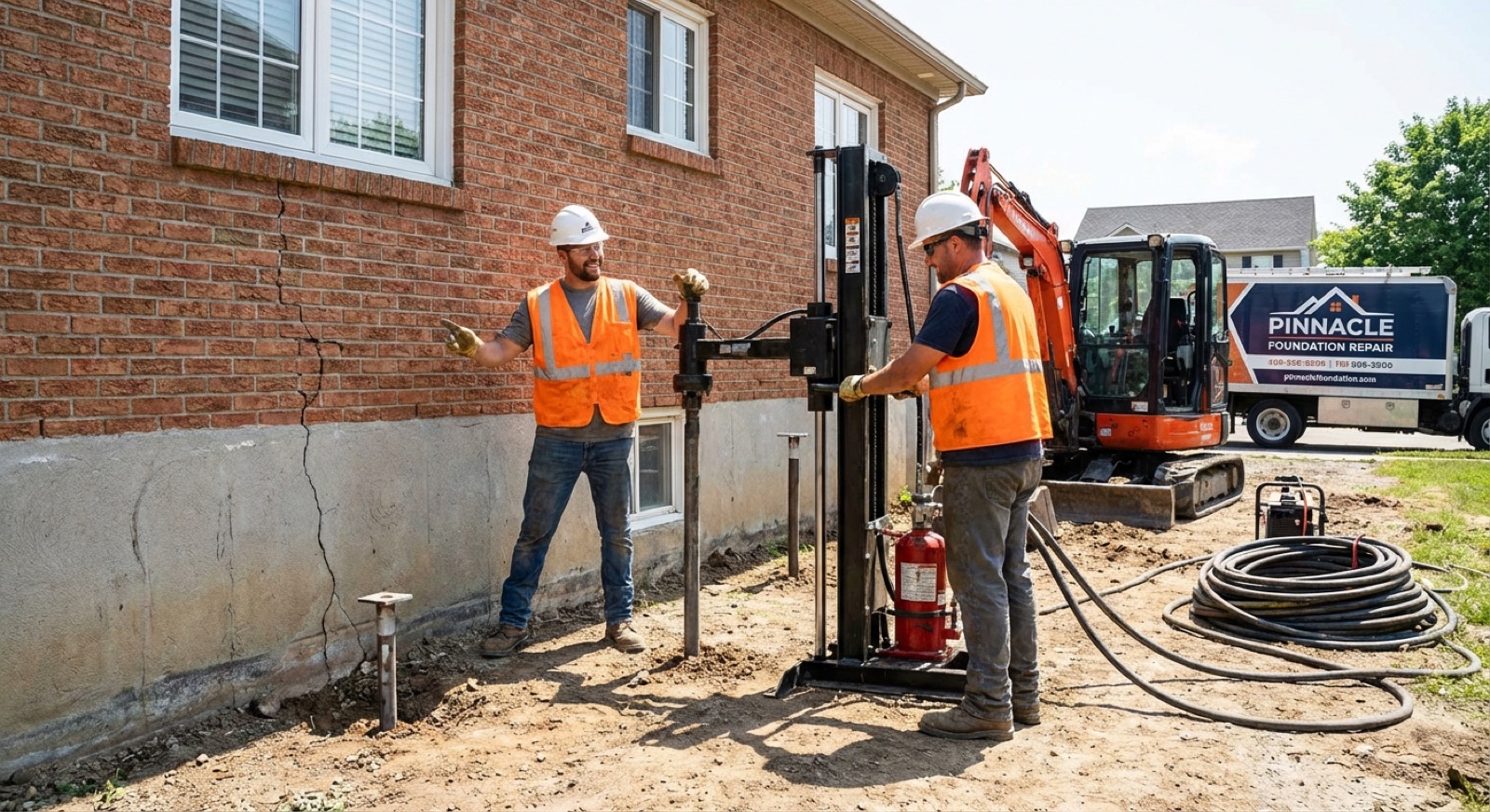
- What House Leveling Is (and Who Needs It)
- Cost Overview by Foundation Type
- Pier and Beam Leveling: $3,000 - $10,000
- Slab Foundation Leveling: $5,000 - $15,000
- Mobile / Manufactured Home Leveling: $2,000 - $5,000
- Crawl Space Foundation Leveling: $4,000 - $12,000
- What Drives the Price Up (or Down)
- How Level Is "Level Enough"?
- Cosmetic Damage After Leveling
- Timeline and Living Arrangements
- Texas-Specific Considerations
- Financing and Insurance
- Questions to Ask Contractors
- Getting the Right Number of Quotes
Your floors slope. A marble rolls to the same corner every time. Doors stick, gaps appear above window frames, and one end of the house seems to sit lower than the other. Something moved -- and now you need to figure out what it costs to fix it.
House leveling is the process of restoring a settled, shifted, or sagging structure to level (or as close to level as the structure will tolerate). It is not the same as foundation repair, though the two often overlap. Foundation repair addresses the root cause of structural failure. House leveling addresses the symptom -- the house itself sitting unevenly -- which may or may not require foundation work depending on the cause.
This guide breaks down real house leveling costs by foundation type, walks through the process for each, and gives you the specific numbers and context to evaluate contractor quotes. Costs are based on 2026 contractor pricing data from across the U.S.
Most residential house leveling projects cost $3,000 to $12,000, with the foundation type being the single biggest cost determinant. Pier and beam homes ($3,000 - $10,000) are generally the least expensive to level because of crawl space access. Slab foundations ($5,000 - $15,000) cost more because the repair methods are more invasive. Mobile homes ($2,000 - $5,000) are the cheapest to level but need to be done correctly to avoid recurring problems.
What House Leveling Is (and Who Needs It)
House leveling corrects the position of a structure that has moved from its original plane. The movement can be vertical (one area sinks lower than another), lateral (a wall leans or shifts sideways), or a combination. The goal is to bring the structure back to a functionally level state -- meaning floors are flat enough for normal use, doors and windows operate properly, and no ongoing structural stress is being applied to the framing.
You likely need house leveling if you notice any combination of these signs:
- Visibly sloping floors -- you can feel the incline when walking, or furniture sits unevenly without shims
- Bouncy or sagging floors -- particularly in pier and beam or crawl space homes where support beams have weakened
- Doors and windows that stick, swing open, or will not latch -- a classic sign that the frame has shifted
- Cracks in drywall, especially diagonal cracks near door and window frames -- these indicate differential settlement
- Gaps between walls and ceilings or walls and floors -- the structure is separating at connection points
- Exterior brick cracks in a stair-step pattern -- mortar joints fail where the wall is bending
- A visible gap between the chimney and the house -- the chimney footing has settled independently
Not every sign requires full house leveling. Hairline cracks in drywall can be normal settling that stabilizes on its own. But if you are seeing multiple signs, especially floor slope you can feel when walking, a professional evaluation is warranted.
Cost Overview by Foundation Type
Your foundation type determines which leveling methods are available, how accessible the work area is, and ultimately what you will pay. Here is the summary view.
| Foundation Type | Typical Cost Range | Common Methods | Avg. Timeline |
|---|---|---|---|
| Pier and Beam | $3,000 - $10,000 | Shimming, pier replacement, beam sistering | 1 - 2 days |
| Slab-on-Grade | $5,000 - $15,000 | Steel/helical piering, mudjacking, foam injection | 1 - 3 days |
| Mobile / Manufactured | $2,000 - $5,000 | Re-shimming, pier replacement, skirting repair | 4 - 8 hours |
| Crawl Space | $4,000 - $12,000 | Post/pier replacement, beam reinforcement, jacking | 1 - 3 days |
Now let us break each one down in detail -- what the process involves, what drives cost within each range, and what to watch for.
Pier and Beam Leveling: $3,000 - $10,000
Pier and beam foundations are the most straightforward to level because the crawl space beneath the house gives contractors direct access to the support structure. No excavation, no drilling through concrete, no heavy hydraulic equipment in most cases. That accessibility is reflected in the lower cost range.
How the Process Works
A pier and beam home sits on a grid of concrete piers (or sometimes cedar stumps in older Texas homes) that support wooden beams, which in turn support the floor joists. When the house settles unevenly, the cause is almost always one or more of these components failing: piers sinking, beams sagging or cracking, or joists weakening from moisture or termite damage.
The leveling process typically follows this sequence:
- Assessment. A technician crawls under the house and measures the level of every pier, beam, and joist. They identify which supports have settled, shifted, or deteriorated.
- Jacking. Hydraulic bottle jacks or screw jacks are placed under the beams at low points and the house is gradually raised -- usually no more than 1/8 inch at a time over multiple passes to avoid cracking the interior finishes.
- Shimming or pier replacement. Once the house reaches the target level, the space between the beam and the pier is filled with hardwood shims, steel shims, or concrete spacers. If the pier itself has failed (crumbled, tilted, or sunk below repair), it is replaced entirely with a new concrete pier.
- Beam repair. If beams are cracked, rotted, or undersized, they are sistered (a new beam bolted alongside the damaged one) or replaced outright.
- Final measurement. The technician re-checks levels across the entire structure and makes fine adjustments.
Cost Breakdown
| Repair Component | Cost Range | Notes |
|---|---|---|
| Shimming (per pier) | $75 - $200 | Most affordable fix; works when piers are intact |
| Pier replacement (per pier) | $300 - $700 | New poured concrete pier; needed when existing pier is crumbled/tilted |
| Beam sistering (per beam) | $250 - $600 | Reinforces weakened beam; less disruptive than full replacement |
| Beam replacement (per beam) | $500 - $1,200 | Full removal + new beam; needed for severe rot or termite damage |
| Joist repair/sistering (per joist) | $100 - $350 | Addresses bouncy/sagging floors between beams |
| Full house leveling (labor) | $2,500 - $5,000 | Base labor cost for jacking + shimming typical home |
A typical pier and beam leveling job on a 1,200-1,800 sq ft home with moderate settling (1-2 inches of slope) involves shimming 10-20 piers, replacing 2-4 failed piers, and sistering 1-2 beams. That puts most homeowners in the $4,000 - $7,000 range.
Costs push toward the $10,000 end when significant beam replacement is needed, the crawl space is shallow (less than 18 inches of clearance makes everything harder), or the home requires extensive re-shimming due to decades of deferred maintenance.
Pier and beam homes can often be re-leveled multiple times over their lifespan because the support structure remains accessible. If you notice new settling 10-15 years after a leveling job, a contractor can go back under the house and adjust. That is not possible with slab foundations.
Slab Foundation Leveling: $5,000 - $15,000
Slab-on-grade foundations present a fundamentally different challenge. There is no crawl space. The concrete slab sits directly on the ground, so all leveling work has to happen either from beneath the slab (piering) or by injecting material through the slab (mudjacking or foam). Both approaches are more equipment-intensive than pier and beam work, and the costs reflect that.
How the Process Works
Slab leveling typically uses one of three methods, depending on the severity and cause of the settlement:
Steel or helical piering ($1,000 - $3,000 per pier) is the gold standard for slab homes with significant settlement. Piers are driven through the slab into stable soil or bedrock, then the foundation is hydraulically lifted back to level. This is the most permanent fix and the most expensive. A typical slab home needs 6-12 piers, putting the total between $6,000 and $36,000 -- though most residential leveling jobs fall in the $8,000-$15,000 range.
Mudjacking ($3 - $6 per square foot) involves drilling 1.5-2 inch holes through the slab and pumping a cement-sand slurry beneath it to fill voids and raise the slab. It is effective for minor to moderate settling (up to about 2 inches) and costs significantly less than piering. A typical mudjacking project runs $500 - $3,000 depending on the area being treated. The tradeoff: the heavy slurry (about 100 lbs per cubic foot) can contribute to future settling on weak soil.
Polyurethane foam injection ($5 - $25 per square foot) works on the same principle as mudjacking but uses expanding polyurethane foam instead of cement slurry. The foam is lighter (about 2 lbs per cubic foot), cures in 15 minutes, and requires smaller drill holes. It costs more per square foot but is less likely to cause re-settling. Total project cost runs $2,000 - $8,000.
Need a Quote for House Leveling?
Compare estimates from up to 3 vetted contractors in your area.
Get Free QuotesSlab Leveling Cost Breakdown
| Method | Cost Range | Best For | Limitations |
|---|---|---|---|
| Steel push piers | $1,000 - $3,000/pier | Severe settling, permanent fix | Highest cost; requires excavation at pier locations |
| Helical piers | $1,200 - $3,500/pier | Lighter structures, no bedrock access | 15-20% pricier than steel; slower install |
| Concrete pressed pilings | $400 - $1,300/piling | Moderate settling on slab (TX/OK/LA) | Does not reach bedrock; friction-dependent |
| Mudjacking | $3 - $6/sq ft | Minor settling, driveways, patios | Heavy material; may re-settle |
| Polyurethane foam | $5 - $25/sq ft | Interior slabs, faster cure | Not a structural underpinning method |
Mudjacking and foam injection level the slab, but they do not address why the slab settled. If the cause is active soil movement (expanding clay, erosion, poor drainage), the slab will likely settle again. Piering addresses the root cause by transferring the foundation's load to stable soil deep underground. If a contractor recommends mudjacking for a home with active settling, get a second opinion.
Mobile / Manufactured Home Leveling: $2,000 - $5,000
Manufactured homes sit on a system of steel I-beams, concrete block piers, and hardwood or steel shims. They are designed to be set and leveled on-site during initial installation, and they are designed to be re-leveled when settling occurs -- which it almost always does within the first few years after placement.
How the Process Works
- Skirting removal. The contractor removes enough skirting panels to access the pier and beam system beneath the home.
- Measurement. Using a water level or laser level, the technician checks every pier location and identifies high and low points. HUD standards require the frame to be within 3/8 inch of level along any 20-foot measurement.
- Jacking. Hydraulic jacks are positioned under the steel I-beams at low points, and the home is raised incrementally.
- Re-shimming. Old shims are removed and replaced. In many cases, the original wooden shims have compressed, split, or rotted. New hardwood or steel shims are installed.
- Pier replacement. If concrete block piers have shifted, crumbled, or sunk, they are rebuilt. Each pier consists of stacked concrete blocks on a concrete footing pad.
- Skirting repair. Damaged skirting panels are repaired or replaced, and the skirting is reattached and sealed.
Cost Breakdown
| Repair Component | Cost Range | Notes |
|---|---|---|
| Basic re-leveling (single-wide) | $800 - $2,000 | Jacking + re-shimming existing piers |
| Basic re-leveling (double-wide) | $1,500 - $3,500 | Marriage wall adds complexity |
| Pier replacement (per pier) | $150 - $400 | Full rebuild with new blocks and footing pad |
| Skirting repair/replacement | $300 - $1,200 | Vinyl skirting; higher for faux stone or brick |
| New tie-down straps | $100 - $300 | Often needed after releveling; code requirement in wind zones |
Most single-wide manufactured home levelings fall between $1,500 and $3,000. Double-wides run $2,500 - $5,000 because of the marriage wall (the joint where the two halves connect), which requires careful alignment and additional pier work at the center line.
Industry guidance is to check level every 3-5 years. Most manufactured homes need at least one re-leveling within the first 2-3 years after initial setup, as the ground compacts under the weight. After that, frequency depends on soil conditions and drainage. In areas with expansive clay, you may need re-leveling every 5-7 years.
Crawl Space Foundation Leveling: $4,000 - $12,000
Crawl space foundations share similarities with pier and beam construction -- there is space beneath the house to access the support structure. The difference is that crawl space foundations typically use perimeter concrete stem walls with interior posts or piers, and they are more susceptible to moisture-related problems (wood rot, mold, termite damage) that can compromise structural supports over time.
How the Process Works
- Access and assessment. Crawl space access is often tighter than a pier and beam home. The technician enters through an access hatch and maps the support system, noting failed posts, sagging beams, moisture damage, and settlement.
- Moisture mitigation (if needed). If standing water or excessive moisture is causing the structural failure, that must be addressed first. French drains, vapor barriers, or sump pumps may be required before leveling. This can add $1,500-$5,000 to the project.
- Jacking and leveling. Hydraulic jacks lift sagging beams. Adjustable steel posts (Lally columns) are installed to replace failed wooden posts or masonry piers.
- Beam reinforcement. Rotted or damaged girders are sistered or replaced. In severe cases, new beams are installed to redistribute load.
- Post/pier installation. New concrete footings are poured, and adjustable steel posts are set on the footings. Adjustable posts allow for fine-tuning the level after initial installation.
Cost Breakdown
| Repair Component | Cost Range | Notes |
|---|---|---|
| Adjustable steel post (per post) | $250 - $500 | Includes new concrete footing |
| Beam sistering (per beam) | $300 - $800 | Higher than pier-and-beam due to access constraints |
| Beam replacement (per beam) | $600 - $1,500 | Full removal in tight crawl space adds labor |
| Vapor barrier installation | $1,200 - $4,000 | 6-20 mil polyethylene; prevents future moisture damage |
| French drain / sump pump | $1,500 - $5,000 | Required if standing water is present |
| Full leveling (labor) | $3,000 - $6,000 | Base labor for jacking + post replacement |
The wide cost range ($4,000 - $12,000) reflects the fact that crawl space projects often involve both the structural leveling work and moisture remediation. A straightforward leveling with post replacement on a dry crawl space runs $4,000-$7,000. Add a vapor barrier and drainage, and you are looking at $8,000-$12,000 or more.
Not Sure What Type of Foundation You Have?
A free inspection will identify your foundation type and the right leveling approach.
Get Free QuotesWhat Drives the Price Up (or Down)
Beyond foundation type, several factors push your project toward the high or low end of the range.
Square Footage
Larger homes require more piers, beams, and labor. A 1,000 sq ft pier and beam home might need 12-15 support points. A 2,500 sq ft home might need 30-40. The relationship is roughly linear -- double the footprint, roughly double the cost -- though there are economies of scale on labor for larger projects.
Number of Piers or Support Points
This is the single most predictable cost driver. Every pier that needs to be shimmed, replaced, or installed adds a fixed per-unit cost. Before signing a contract, make sure the scope specifies exactly how many piers are included and what happens if additional piers are needed once the work begins.
Accessibility
A pier and beam crawl space with 30 inches of clearance is fast to work in. One with 12 inches of clearance requires technicians to army-crawl to every pier, dramatically increasing labor time. Crawl space access hatches in closets or finished rooms add more complexity. Expect a 20-40% cost increase for difficult-access crawl spaces.
Severity of Settlement
A house that has settled 1 inch in one corner is a different project than one that has dropped 4 inches across an entire side. Greater settlement means more lifting, more pier work, and a higher risk of secondary damage (cracked plumbing, broken utilities) during the leveling process. Each additional inch of settlement adds roughly 15-25% to the base cost.
Soil Conditions
Expansive clay soil (common across Texas, Oklahoma, the Gulf Coast, and parts of the Southeast) is the most problematic. It swells when wet and shrinks when dry, creating a cycle of heaving and settling that can require deeper pier installation and more aggressive stabilization. Sandy or loamy soil is more stable but can erode if drainage is poor. Rocky soil is great for bearing capacity but expensive to drill through for pier installation.
Permits and Engineering
Some municipalities require a building permit for house leveling, particularly if structural modifications are involved. Permits typically run $75-$300. If an independent structural engineer's report is required (or recommended), add $300-$700. The engineering report is almost always worth the cost -- it gives you an objective scope of work to measure contractor bids against.
Plumbing and Utilities
For slab foundations especially, plumbing runs through or beneath the slab. Leveling a slab can stress these lines, and a plumbing test is often recommended before and after the work. If the leveling process reveals or causes a plumbing leak, add $500-$3,000 for repairs -- and that cost is separate from the leveling contract in most cases.
How Level Is "Level Enough"?
This is one of the most common points of confusion -- and frustration -- for homeowners. Here is the reality: perfectly level is not always achievable, and chasing it can actually cause more damage than it prevents.
The widely accepted tolerance is 1/2 inch of slope per 20 feet of span. This means in a 40-foot-long house, up to 1 inch of total variance across the full length is considered within acceptable limits. Most homeowners cannot perceive a 1/2-inch-per-20-foot slope without measuring instruments.
Several factors make perfect level impractical:
- Structural stress. Over-lifting a foundation can crack framing members, break plumbing connections, and separate drywall seams. The house has adapted to its settled position over years or decades. Forcing it back to factory-spec level introduces counter-stresses that the aged structure may not tolerate.
- Material memory. Wood beams and joists that have sagged for years develop a permanent set. Even after the supports are leveled, the lumber itself retains some of its curved shape.
- Soil response. Lifting one section of a foundation changes the load distribution on the soil beneath adjacent sections. Over-correcting in one area can trigger new settling elsewhere.
- Cost escalation. Chasing that last 1/4 inch of variance can add 30-50% to the project cost for diminishing returns. A reputable contractor will tell you this. An unscrupulous one will charge you for the extra work without mentioning the diminishing benefit.
If a contractor promises to make your house "perfectly level," be cautious. Experienced leveling contractors set expectations early: they will bring it within acceptable tolerances and monitor for continued movement. Perfection is the wrong goal.
Cosmetic Damage After Leveling
This catches many homeowners off guard: leveling your house will likely create new cosmetic damage, even as it fixes the structural problem. It is not a sign that the work was done wrong. It is a predictable consequence of moving a rigid structure.
When a settled house is lifted back toward level, the movement reverses the stresses that were holding things in place. Drywall cracks that had "stabilized" may widen or new cracks may appear in different locations. Door frames that were jammed may now have gaps. Trim and molding may separate. Plan and budget for cosmetic repair as a separate line item.
Typical post-leveling cosmetic repairs include:
- Drywall patching and repainting: $200 - $800 for spot repairs; $1,000 - $3,000 for extensive patching across multiple rooms
- Door and window re-fitting: $75 - $200 per door/window to plane, re-hang, or replace hardware
- Trim and molding reattachment: $100 - $500 depending on extent
- Tile or flooring repair: $200 - $1,500 if rigid flooring (tile, hardwood) cracks during the lift
- Exterior brick or stucco repair: $300 - $2,000 for mortar repointing or crack patching
A reasonable budget for cosmetic touch-up after a typical residential leveling job is $500 - $2,000. This is separate from the leveling contractor's scope -- cosmetic repair is usually handled by a drywall contractor, painter, or general handyman after the leveling is complete and the house has had 2-4 weeks to settle into its new position.
Most experienced leveling contractors will warn you about this upfront. If a contractor tells you there will be zero cosmetic damage after lifting a house 2 inches, they are either inexperienced or not being straight with you.
Timeline and Living Arrangements
How Long Does House Leveling Take?
Most residential house leveling projects take 1 to 3 days. Here is a more specific breakdown:
- Mobile / manufactured home: 4 to 8 hours for a standard re-level; full day if piers need replacement
- Pier and beam (minor-moderate): 1 day for shimming and minor pier replacement
- Pier and beam (extensive): 2-3 days if significant beam work or pier replacement is needed
- Slab with piering: 1-3 days depending on number of piers; foam injection is usually same-day
- Crawl space with moisture work: 2-4 days if drainage and vapor barrier installation are included
Can You Live in the House During Leveling?
In most cases, yes. Residential house leveling is not as disruptive as homeowners typically expect. The work happens beneath or around the home, not inside it. Furniture generally does not need to be moved. Utilities (water, electric, gas) usually remain on throughout the process, though a plumbing shutoff may be required during the actual lifting phase on slab homes.
Situations where you might need to vacate temporarily:
- Severe settlement requiring a lift of 3+ inches, where the risk of utility disruption is higher
- Slab foundation work that requires excavation near the perimeter of the home
- Homes with known gas line issues in the slab (a plumber should verify before leveling begins)
- Elderly, disabled, or very young household members who would be affected by noise and vibration during the jacking process
For the typical 1-2 day residential leveling job, plan to be home. You will want to monitor the process and be available if the contractor has questions or discovers unexpected conditions.
Texas-Specific Considerations
Texas is the largest market in the country for house leveling, and it is not close. The combination of expansive clay soil, extreme seasonal temperature swings, a massive stock of pier and beam homes (especially in the DFW, Houston, Austin, and San Antonio metros), and a climate that alternates between drought and deluge creates near-constant demand for leveling and foundation work.
Texas accounts for roughly 20-25% of all foundation repair and leveling work performed in the U.S. annually. The DFW metroplex alone has more foundation repair companies than most entire states. Houston's black clay (Beaumont Clay formation) is among the most expansive soil in the country.
Clay Soil and the Seasonal Cycle
Texas clay soil can expand by 10-15% when saturated and shrink dramatically during drought. This creates a seasonal heaving-and-settling cycle that is the primary driver of foundation movement across the state. Summer drought pulls moisture from the soil, causing it to contract and pull away from foundations. Winter and spring rains re-saturate the soil, which swells and pushes against the foundation from below and the sides.
Many Texas foundation companies recommend a foundation watering program during summer months: soaker hoses placed 12-18 inches from the foundation perimeter, running for 15-20 minutes daily when there has been no rain for a week or more. This is not a gimmick -- maintaining consistent soil moisture reduces the heave-settle cycle and can prevent or slow future leveling needs.
Summer vs. Winter: When to Schedule
Foundation contractors in Texas are busiest in spring (March-May) after the wet season reveals winter damage, and in fall (September-November) after summer drought causes visible settling. If your situation is not urgent, scheduling during the slow periods (June-August and December-February) can save 10-15% and get you shorter wait times for the appointment. Some Texas contractors offer explicit off-season pricing.
Pier and Beam Prevalence
Texas has one of the highest concentrations of pier and beam homes in the country, particularly in older neighborhoods built before the 1960s. Many of these homes used cedar post foundations -- untreated cedar stumps set directly in the ground -- which have a functional lifespan of 30-50 years. Homes built in the 1940s-1960s on cedar posts are prime candidates for leveling and pier replacement today. This is one reason Texas leveling costs can be slightly lower than the national average: the volume of work keeps competition high and pricing competitive.
Texas-Specific Costs
Pier and beam leveling in Texas typically runs $2,500 - $8,000 (slightly below the national range) due to market competition. Slab foundation work with pressed pilings -- the most common slab repair method in Texas -- runs $4,000 - $12,000 for a typical residential job with 8-15 pilings.
Compare House Leveling Quotes
Get matched with vetted contractors in your area. Free, fast, zero pressure.
Get Free QuotesFinancing and Insurance
Does Homeowners Insurance Cover House Leveling?
In the vast majority of cases, no. Standard homeowners insurance policies exclude earth movement, settling, and foundation failure. These are classified as maintenance issues, not sudden or accidental events. The logic (from the insurer's perspective) is that foundation settlement is a gradual, predictable process that homeowners should address proactively.
There are narrow exceptions:
- Plumbing leak damage: If a covered plumbing failure (sudden pipe burst, not gradual leak) causes soil erosion that leads to settling, the resulting foundation damage may be covered. Documentation and timing matter -- you need to prove the plumbing event caused the settlement.
- Natural disaster riders: Some policies or riders cover earthquake or flood damage to foundations. These are separate endorsements with additional premiums and are not included in standard policies.
- Builder's warranty: New construction typically carries a structural warranty (often 10 years) from the builder. If settling occurs within the warranty period, the builder is responsible for repair. Review the warranty language carefully -- many have exclusions for "normal settling."
File a claim if you believe a covered event contributed to the damage, but do not count on insurance to pay for house leveling. It almost never does.
Financing Options
Most homeowners pay for leveling through one of these channels:
- Contractor financing: Many larger foundation companies offer 0% for 12-18 months or low-rate payment plans. Read the terms -- deferred interest plans charge the full accumulated interest if the balance is not paid in full by the promotional period's end.
- Home equity line of credit (HELOC): If you have equity in your home, a HELOC typically offers the lowest interest rates (6-9% in 2026). The drawback is the 2-4 week approval process.
- Personal loan: Unsecured personal loans from banks or online lenders offer fast funding (often within days) at rates of 7-15% depending on credit. No home equity required.
- Credit card: Not ideal for the full amount due to high interest rates, but can work for smaller leveling jobs ($2,000-$3,000) if you plan to pay it off within a few months. Some contractors accept credit cards; many do not for larger jobs due to processing fees.
- FHA 203(k) loan: If you are purchasing a home that needs leveling, the FHA 203(k) rehabilitation loan rolls the repair cost into the mortgage. This requires a licensed contractor and an approved scope of work.
Questions to Ask Every Contractor
Before hiring a house leveling contractor, ask every candidate these questions. Their answers will tell you a lot about their competence, integrity, and whether their quote is realistic.
- "How many piers/support points are included in this quote, and what happens if you discover additional ones are needed?" -- The scope should be specific. "As many as needed" is vague and sets up a dispute later. Get an exact count and a per-unit cost for additional work.
- "What level tolerance are you targeting?" -- The answer should be something like "within 1/2 inch per 20 feet." If they promise "perfectly level," they are either setting unrealistic expectations or do not understand the limitations.
- "What warranty do you provide, and is it transferable?" -- Look for a minimum 10-year warranty (lifetime is common for piering). Transferability matters if you plan to sell the home.
- "Do you carry general liability insurance and workers' comp?" -- If a worker is injured on your property without workers' comp, you could be liable. Ask for a certificate of insurance.
- "Will the work require a building permit?" -- The contractor should know your local code requirements. If they say "we do not pull permits," that is a red flag.
- "How do you handle plumbing during the leveling process?" -- For slab foundations especially, the contractor should be able to explain how they protect plumbing lines during the lift, and whether a pre- or post-leveling plumbing test is recommended.
- "What cosmetic damage should I expect after the leveling is complete?" -- An honest contractor will prepare you for drywall cracks, sticking doors, and potential tile damage. Silence on this topic is a bad sign.
- "Can I see photos or contact info for 3 recent customers with similar work?" -- References for the specific type of work you need (not just general references) are the most valuable.
- "What is your payment schedule?" -- Industry standard is 0-10% upfront with the balance due upon completion and your inspection. A contractor asking for 50% upfront is a risk.
Getting the Right Number of Quotes
The standard advice is "get three quotes," and it is good advice -- but with caveats.
Three is the minimum, not the magic number. Three quotes give you enough data points to identify whether one bid is an outlier (too high or too low). If all three are within 15-20% of each other, you have a reliable price range. If one bid is 40% below the others, it is either cutting corners or missing something in the scope. If one is 40% above, it may be padding the quote or recommending unnecessary work.
Make sure all contractors are bidding on the same scope. This is the most common mistake homeowners make. Contractor A quotes shimming and 5 new piers. Contractor B quotes shimming only. Contractor C quotes 10 new piers, full beam replacement, and a vapor barrier. These are three different projects, and comparing their prices side-by-side is meaningless. Have each contractor put the scope in writing, then compare apples to apples.
An independent structural engineer's report is the great equalizer. For $300-$700, you get an objective assessment of what the house actually needs. Hand that report to all three contractors and ask them to bid against it. Now you are comparing identical scopes, and the differences in price reflect labor efficiency, overhead, and margin -- not differences in opinion about what work is needed.
Do not automatically choose the cheapest. Warranty quality, crew experience, reputation, and responsiveness all matter. The lowest bidder who shows up three weeks late, uses inferior materials, and provides a 5-year warranty is not a better value than the mid-range bidder who starts next week, uses high-quality materials, and provides a transferable lifetime warranty.
House leveling is a significant but manageable investment that protects your home's structural integrity and resale value. Get an independent assessment, collect at least three written quotes on the same scope of work, verify credentials and insurance, and do not chase "perfectly level." The goal is a structurally sound home with floors that feel flat, doors that close, and no ongoing movement -- and for most residential projects, that costs between $3,000 and $12,000.
That is exactly the kind of comparison Foundation Pro was built to help with.